Bitumen: Types, Grades, Uses & Buying Guide
Petroleum Commodities · Buying Guide

Bitumen
Explained

The binder beneath every road, roof, and pipeline coating. A concise guide to grades, specifications, applications, and what to check before you place an order.

Primary UseRoad & Asphalt
Common Grade60/70
SourceCrude Residue
CRUDE RESIDUE BINDER
Fundamentals

What is bitumen?

Bitumen is produced from the heavy residue left after refining crude oil. It acts as the binder that holds mineral aggregate together to form asphalt.

Bitumen
=
Binder
·
Asphalt
=
Aggregates
+
Bitumen
+
Fillers
Product Range

Main types of bitumen

Four product families cover the vast majority of global trade and industrial demand.

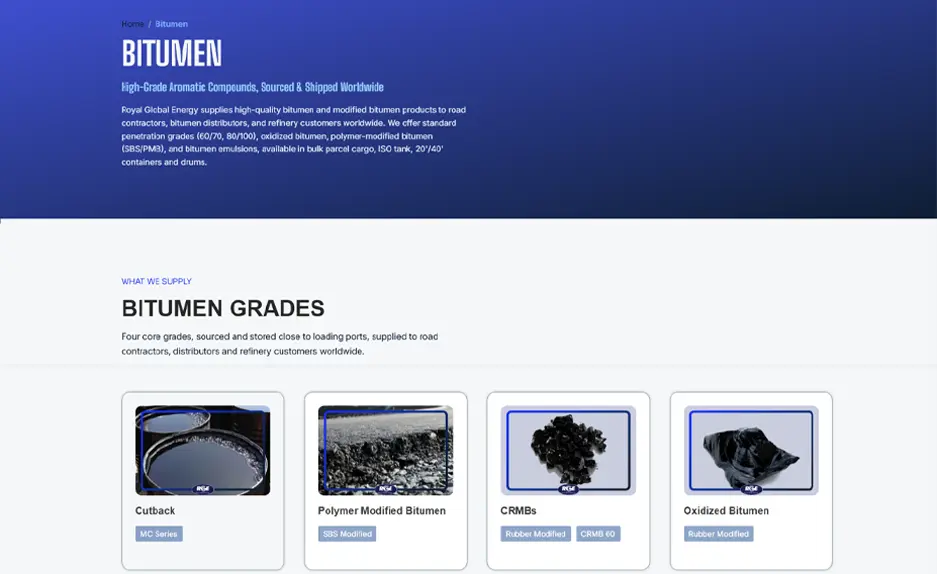
01 / Penetration Grade

Penetration Grade

Classified by penetration depth and hardness. The most widely traded form of bitumen worldwide.

40/5060/7080/100100/120160/220
02 / PMB

Polymer Modified

Modified with polymers such as SBS for improved elasticity, rutting resistance, fatigue resistance, and temperature performance.

HighwaysBridgesAirports
03 / Oxidized

Oxidized (Blown)

Produced by controlled air blowing. Suited to roofing, waterproofing, pipe coatings, sealants, and industrial applications.

RoofingWaterproofingCoatings
04 / Emulsion

Bitumen Emulsion

A water-based bitumen product used for road maintenance, surface treatments, tack coats, and cold-mix applications.

MaintenanceTack CoatCold-Mix
The Penetration Test

Reading the grade spectrum

Penetration grade is measured by how far a standard needle sinks into a bitumen sample under fixed load, time, and temperature. Lower numbers mean a harder binder; higher numbers mean a softer one.

Penetration Grade Scale

ASTM D5 · 25°C · 100g · 5s
Needle depth animates the test in real time
40/50
Hardest
60/70
Common
80/100
Standard
100/120
Softer
160/220
Softest
Harder · More rigidSofter · More flexible
Most Traded Grade

60/70

One of the most commonly traded paving grades internationally, offering a practical balance between hardness, flexibility, adhesion, and workability.

  • Road construction
  • Highways
  • Asphalt production
  • Airport pavements
  • Infrastructure projects
Data Sheet

Key specifications to check

Quality parameters that determine how a bitumen performs in the field.

Penetration
Indicates consistency and hardness
Softening Point
Indicates high-temperature behavior
Ductility
Measures stretching ability
Viscosity
Indicates resistance to flow
Flash Point
Important for safe handling
Solubility
Helps assess material composition

Products should comply with the required ASTM, EN, AASHTO, or other applicable standards.

Applications

Where bitumen is used

Road Construction

The largest application, where bitumen binds aggregates to produce durable asphalt.

Roofing & Waterproofing

Protects buildings, foundations, tunnels, and other structures against water penetration.

Industrial

Used in coatings, sealants, pipe protection, adhesives, and corrosion-resistant materials.

Procurement

What affects bitumen price?

For international buyers, shipping and packaging costs can significantly impact the final delivered price.

Crude Oil Prices
Grade
Refinery Supply
Freight
Packaging
Origin
Demand
Logistics

Packaging & transportation

The appropriate method depends on quantity, destination, handling facilities, and product grade.

Bulk

Large-volume shipments for tankers and industrial handling facilities.

Steel Drums

Standard sealed drums for smaller volumes and long-distance freight.

Jumbo Bags

Bitubags for palletized handling, easier storage, and flexible delivery.

Before You Order

What buyers should check

Grade and specification
Certificate of Analysis (COA)
Penetration & Softening Point
Origin
Packaging
Quantity
Loading port
Destination
Inspection requirements
Delivery terms
Looking for Bitumen Supply?

60/70, 80/100, PMB, or Oxidized —
tell us the spec.

Contact our commercial team with your required grade, quantity, packaging, destination, and delivery terms.